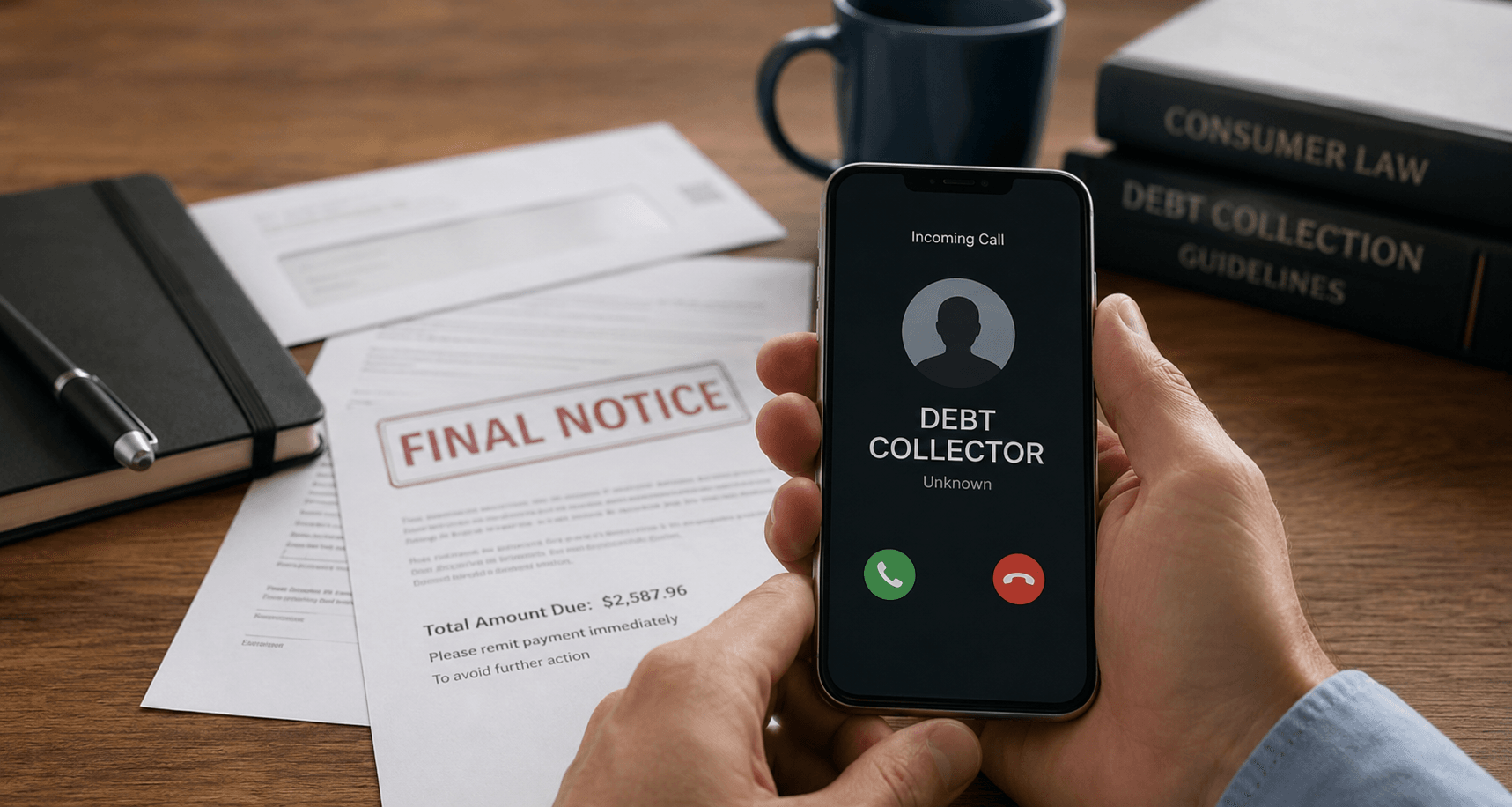
It usually starts with a letter, a missed call, or a message saying you owe money. Most people either panic or ignore it. Neither helps.
In Australia, first contact usually comes through phone, letter, email, or SMS. A compliant collector identifies themselves by name, names the agency, names the original creditor, and references the debt by amount and account. If any of those are missing, take note.
The rulebook here is the ACCC and ASIC's Debt Collection Guideline, updated in April 2021. It's the operative reference for what collectors can and can't do, covering contact frequency, hours, workplace rules and third-party enquiries. It's enforceable. Agencies that ignore it lose licences and cop regulator action.
That matters because you've got leverage from the first sentence. The collector knows the rules better than you do, and they know what happens when they break them. What a licensed Australian debt collector can do is bound by law, not by what they feel like doing on the day.
Before you respond
Don't confirm anything. Not your full name, not your address, not whether the debt is yours. You're allowed to take the call, listen, and call back once you've verified who they are. This guidance applies to personal debt collection contact specifically; business debts follow a different process.
First, Three Things
Three moves to lock in before you do anything else.
Don't confirm your identity or pay anything until you've verified the caller. Real collectors expect this. Scammers hate it. If they push back hard, they're not who they say they are.
Ask for the debt in writing. You want the creditor's name, the amount, the date the debt arose, and the account or invoice reference. A legitimate agency provides this without argument. Verifying the caller starts with that paper trail.
Log every contact. Date, time, channel, who called, what they said. If the frequency or tone ever crosses the ACCC's lines, that log is your evidence.
Real Collector or Scam? Here's How to Tell
Phishing scams imitate debt collectors because the script works. Fear, urgency, vague threats about court or arrest. The difference becomes clear as soon as you ask for details. Legitimate collectors will identify themselves, explain the debt clearly, and provide verification. Scammers usually avoid specifics or push you to act immediately.
A legitimate Australian agency holds a Commercial Agent licence in the state it operates from, and an Australian Credit Licence if it collects consumer credit debt. You can cross-check the business on ABN Lookup and ASIC Connect in under two minutes. If the agency claims to act for a specific creditor, ring that creditor directly using a number you find yourself, not the one the caller gave you. Ask whether they've placed your account with that agency.
Red flags worth treating as confirmation of a scam:
Demands payment by gift card, cryptocurrency, or wire transfer
Threatens immediate arrest, deportation or court action without notice
Refuses to send anything in writing
Pressures you to pay within minutes or hours
Spoofed numbers that don't match any registered Australian business
The ACCC and ASIC's 2021 guideline sets hard ceilings on how often, when, and where a collector can contact you. These aren't suggestions. Regulators treat repeated breaches as harassment or undue pressure.
What
Limit
Phone calls
Max 3 per week, 10 per month, and only when necessary
Call hours (weekdays)
7:30am to 9pm
Call hours (weekends)
9am to 9pm
National public holidays
No contact
Workplace contact
During your working hours, or 9am to 5pm weekdays if unknown
Face-to-face visits
Max once per month, only when necessary
Third-party location enquiries
Max once every 6 months
Anything beyond this is a breach. Repeated calls hour after hour, threats, abusive language, calls to your kids or your boss. You can complain to the ACCC, ASIC, or AFCA. You can also ask the agency in writing to limit contact to a single channel like email or post.
One important point about workplace contact. A collector can call you at work, but they cannot discuss your debt with anyone else there.
If you tell them your employer doesn’t allow personal calls, they must stop using that number.
How to Handle Contact, in Order
Step by step.
Once you've taken the first call and logged it, work through these six steps in order. Skipping ahead is how people end up paying debts that aren't theirs.
Step 1: Verify legitimacy
Check the agency's ABN, Commercial Agent licence, and Credit Licence. Ring the original creditor on a number you find independently. Confirm they've placed your account with this agency, and that the amount matches. If anything's off, stop there and treat the contact as suspect until proven otherwise.
Step 2: Request debt details in writing
Ask for a written statement showing the original creditor, the principal amount, any interest or fees added, the date the debt arose, and the account reference. A legitimate collector sends this without resistance. You're not obligated to discuss anything further until you've received it and read it.
Step 3: Check the debt is actually yours
Identity theft. Billing errors. Debts you've already paid. Debts that have passed the limitation period. All of these happen more than people realise. Most states cap simple contract debts at six years from the last payment or written acknowledgement. If the debt is older than that and you haven't acknowledged it, the statute of limitations is the first thing your response should address.
Step 4: Know your rights
The ACCC rules above apply to every licensed collector. You also have the right to dispute the debt, request contact only by a specific channel, and ask the collector to stop calling you at work. Worth knowing on credit-file impact: the OAIC says a default can only be listed if the payment is at least 60 days overdue, the amount is $150 or more, a second notice was sent at least 30 days after the first, and the provider waits 14 days after the second notice before listing. That's your window to engage before lasting damage.
Step 5: Decide your response
You've got three real options. Pay it in full if you can and it's confirmed yours. Negotiate a payment plan, which most agencies will offer if you ask, especially for genuine hardship. Or formally dispute it in writing if you believe it isn't yours, isn't accurate, or is out of time. Whatever you choose, get it in writing both ways.
Step 6: Get free help if you're stuck
The National Debt Helpline runs free, independent financial counselling on 1800 007 007. They're not connected to any collector or creditor. If you're struggling with multiple debts, hardship, or just don't know where to start, ring them before you ring anyone else.
What If You Just Ignore It?
The hope is that it goes away. It doesn't. For the full picture on ignoring a debt collector, the cost only builds over time.
One of the first impacts is your credit file. Under OAIC guidelines, a default can be listed when a payment is more than 60 days overdue, the amount is at least $150, and the required notice process has been followed. That listing typically stays on your file for five years.It can affect more than just borrowing. It may influence home loans, car finance, phone contracts, and even rental applications.
Second, escalation. The creditor or collector can take the debt to court. If they win and you don't respond, default judgment is entered against you. That judgment sits on your credit file for seven years, and it opens the door to enforcement orders, including attachment of earnings and garnishee orders against your bank account.
Third, cost. Court fees, legal fees, interest. By the time enforcement starts, the $2,000 debt you ignored might be $4,000 or more. Ignoring legitimate collection contact rarely costs you just the original number.
Engaging early, even if you can’t pay immediately, usually leads to better outcomes and lower overall cost. Most collectors prefer to agree on a payment plan or settlement rather than move to legal action, since litigation is time-consuming and expensive for both sides.
Yes, but with strict limits. ACCC guidance says face-to-face contact should be limited to no more than once per month and only when necessary, such as when other contact attempts have failed.
Collectors cannot enter your property without permission, refuse to leave when asked, or visit at unreasonable hours. They also cannot bring police, threaten removal of goods, or suggest they have enforcement powers they do not have. Only a court-appointed sheriff or bailiff can enforce a judgment, and only after a court order. If a collector behaves improperly, document it, ask them to leave, and report it to the ACCC or your state fair trading body.
Yes, but narrowly. They can ring you at work during your normal working hours if they know them, or between 9am and 5pm on weekdays if they don't. They can't discuss the debt with your employer, your colleagues, or anyone else at the workplace. If you tell them your employer doesn't allow personal calls at work, they have to stop calling that number. The safest move is to tell them in writing which channel you prefer, email or your personal mobile, and they're expected to honour it.
The ACCC recommends a maximum of three phone calls per week and ten per month, and only when contact is necessary. There's no ceiling on letters or emails as such, but the same principle applies. Contact should be reasonable, not harassing. Repeated calls in the same day, multiple agencies pursuing the same debt simultaneously, or contact across multiple channels at once can all amount to undue pressure.
No. A collector can contact a third party only to obtain your location information, and only if they can't reach you directly. Even then, it should happen no more than once every six months per third party, unless that person has agreed to further contact. They can't disclose that you owe a debt, name the creditor, or discuss the amount. Doing so is a breach of privacy and the ACCC guideline.
SMS is allowed within the same hours as phone contact. Social media is murkier. A collector can use a private channel to make initial contact if they can't reach you any other way, but they can't post on your public profile, comment on your photos, or contact your friends through the platform. If they do, that's a privacy breach worth reporting.
Start with the agency itself. Most have an internal dispute resolution process and are required to respond within a set time. If that fails or they're not a member of an external scheme, escalate to AFCA, which handles financial services complaints including credit collection. The ACCC handles complaints about general conduct and misleading practices, ASIC oversees credit licence holders, and your state or territory fair trading office covers commercial agent licensing. The National Debt Helpline on 1800 007 007 can talk you through which body fits your situation.
Dispute it in writing. State clearly that you don't acknowledge the debt and explain why. Identity theft, mistaken identity, already paid, or outside the limitation period. Ask the collector to provide proof, and don't make any payment or written acknowledgement in the meantime because that can reset the clock. If you're not sure whether the debt is time-barred, get advice from the National Debt Helpline or a community legal centre before responding. When landlords hand a debt to collectors, the same rules apply. The debt has to be valid, current, and yours.
James has operated businesses since his late teens including windsurfer hire (1977 – 1981), yacht charter (1990 – 2001), motor accident repairs (1984 – 1989) and debt recovery (2002 to the present). He holds a B.A. and LL.B. from Monash University and was admitted as a lawyer in 1983. He is also a Graduate of the Australian Institute of Company Directors.
+613 8611 2610
Linkedin
james.woods@ecollect.com.au
Let’s recover your debts without the stress
We make debt recovery simple, fast, and results-driven. Upload your files, track progress in real-time, and only pay when we collect.
From proactive receivables management through to complex legal recoveries, the eCollect Group provides an integrated, transparent, and results-driven solution — powered by technology, guided by expertise, and delivered by people who treat your business like their own.
Expanding our debt recovery expertise across the United Kingdom market, supported by advanced systems, industry trained specialists and a proven no-recovery, no-charge model.
It usually starts with a letter, a missed call, or a message saying you owe money. Most people either panic or ignore it. Neither helps.
In Australia, first contact usually comes through phone, letter, email, or SMS. A compliant collector identifies themselves by name, names the agency, names the original creditor, and references the debt by amount and account. If any of those are missing, take note.
The rulebook here is the ACCC and ASIC's Debt Collection Guideline, updated in April 2021. It's the operative reference for what collectors can and can't do, covering contact frequency, hours, workplace rules and third-party enquiries. It's enforceable. Agencies that ignore it lose licences and cop regulator action.
That matters because you've got leverage from the first sentence. The collector knows the rules better than you do, and they know what happens when they break them. What a licensed Australian debt collector can do is bound by law, not by what they feel like doing on the day.
Before you respond
Don't confirm anything. Not your full name, not your address, not whether the debt is yours. You're allowed to take the call, listen, and call back once you've verified who they are. This guidance applies to personal debt collection contact specifically; business debts follow a different process.
First, Three Things
Three moves to lock in before you do anything else.
Don't confirm your identity or pay anything until you've verified the caller. Real collectors expect this. Scammers hate it. If they push back hard, they're not who they say they are.
Ask for the debt in writing. You want the creditor's name, the amount, the date the debt arose, and the account or invoice reference. A legitimate agency provides this without argument. Verifying the caller starts with that paper trail.
Log every contact. Date, time, channel, who called, what they said. If the frequency or tone ever crosses the ACCC's lines, that log is your evidence.
Real Collector or Scam? Here's How to Tell
Phishing scams imitate debt collectors because the script works. Fear, urgency, vague threats about court or arrest. The difference becomes clear as soon as you ask for details. Legitimate collectors will identify themselves, explain the debt clearly, and provide verification. Scammers usually avoid specifics or push you to act immediately.
A legitimate Australian agency holds a Commercial Agent licence in the state it operates from, and an Australian Credit Licence if it collects consumer credit debt. You can cross-check the business on ABN Lookup and ASIC Connect in under two minutes. If the agency claims to act for a specific creditor, ring that creditor directly using a number you find yourself, not the one the caller gave you. Ask whether they've placed your account with that agency.
Red flags worth treating as confirmation of a scam:
Demands payment by gift card, cryptocurrency, or wire transfer
Threatens immediate arrest, deportation or court action without notice
Refuses to send anything in writing
Pressures you to pay within minutes or hours
Spoofed numbers that don't match any registered Australian business
The ACCC and ASIC's 2021 guideline sets hard ceilings on how often, when, and where a collector can contact you. These aren't suggestions. Regulators treat repeated breaches as harassment or undue pressure.
What
Limit
Phone calls
Max 3 per week, 10 per month, and only when necessary
Call hours (weekdays)
7:30am to 9pm
Call hours (weekends)
9am to 9pm
National public holidays
No contact
Workplace contact
During your working hours, or 9am to 5pm weekdays if unknown
Face-to-face visits
Max once per month, only when necessary
Third-party location enquiries
Max once every 6 months
Anything beyond this is a breach. Repeated calls hour after hour, threats, abusive language, calls to your kids or your boss. You can complain to the ACCC, ASIC, or AFCA. You can also ask the agency in writing to limit contact to a single channel like email or post.
One important point about workplace contact. A collector can call you at work, but they cannot discuss your debt with anyone else there.
If you tell them your employer doesn’t allow personal calls, they must stop using that number.
How to Handle Contact, in Order
Step by step.
Once you've taken the first call and logged it, work through these six steps in order. Skipping ahead is how people end up paying debts that aren't theirs.
Step 1: Verify legitimacy
Check the agency's ABN, Commercial Agent licence, and Credit Licence. Ring the original creditor on a number you find independently. Confirm they've placed your account with this agency, and that the amount matches. If anything's off, stop there and treat the contact as suspect until proven otherwise.
Step 2: Request debt details in writing
Ask for a written statement showing the original creditor, the principal amount, any interest or fees added, the date the debt arose, and the account reference. A legitimate collector sends this without resistance. You're not obligated to discuss anything further until you've received it and read it.
Step 3: Check the debt is actually yours
Identity theft. Billing errors. Debts you've already paid. Debts that have passed the limitation period. All of these happen more than people realise. Most states cap simple contract debts at six years from the last payment or written acknowledgement. If the debt is older than that and you haven't acknowledged it, the statute of limitations is the first thing your response should address.
Step 4: Know your rights
The ACCC rules above apply to every licensed collector. You also have the right to dispute the debt, request contact only by a specific channel, and ask the collector to stop calling you at work. Worth knowing on credit-file impact: the OAIC says a default can only be listed if the payment is at least 60 days overdue, the amount is $150 or more, a second notice was sent at least 30 days after the first, and the provider waits 14 days after the second notice before listing. That's your window to engage before lasting damage.
Step 5: Decide your response
You've got three real options. Pay it in full if you can and it's confirmed yours. Negotiate a payment plan, which most agencies will offer if you ask, especially for genuine hardship. Or formally dispute it in writing if you believe it isn't yours, isn't accurate, or is out of time. Whatever you choose, get it in writing both ways.
Step 6: Get free help if you're stuck
The National Debt Helpline runs free, independent financial counselling on 1800 007 007. They're not connected to any collector or creditor. If you're struggling with multiple debts, hardship, or just don't know where to start, ring them before you ring anyone else.
What If You Just Ignore It?
The hope is that it goes away. It doesn't. For the full picture on ignoring a debt collector, the cost only builds over time.
One of the first impacts is your credit file. Under OAIC guidelines, a default can be listed when a payment is more than 60 days overdue, the amount is at least $150, and the required notice process has been followed. That listing typically stays on your file for five years.It can affect more than just borrowing. It may influence home loans, car finance, phone contracts, and even rental applications.
Second, escalation. The creditor or collector can take the debt to court. If they win and you don't respond, default judgment is entered against you. That judgment sits on your credit file for seven years, and it opens the door to enforcement orders, including attachment of earnings and garnishee orders against your bank account.
Third, cost. Court fees, legal fees, interest. By the time enforcement starts, the $2,000 debt you ignored might be $4,000 or more. Ignoring legitimate collection contact rarely costs you just the original number.
Engaging early, even if you can’t pay immediately, usually leads to better outcomes and lower overall cost. Most collectors prefer to agree on a payment plan or settlement rather than move to legal action, since litigation is time-consuming and expensive for both sides.
Yes, but with strict limits. ACCC guidance says face-to-face contact should be limited to no more than once per month and only when necessary, such as when other contact attempts have failed.
Collectors cannot enter your property without permission, refuse to leave when asked, or visit at unreasonable hours. They also cannot bring police, threaten removal of goods, or suggest they have enforcement powers they do not have. Only a court-appointed sheriff or bailiff can enforce a judgment, and only after a court order. If a collector behaves improperly, document it, ask them to leave, and report it to the ACCC or your state fair trading body.
Yes, but narrowly. They can ring you at work during your normal working hours if they know them, or between 9am and 5pm on weekdays if they don't. They can't discuss the debt with your employer, your colleagues, or anyone else at the workplace. If you tell them your employer doesn't allow personal calls at work, they have to stop calling that number. The safest move is to tell them in writing which channel you prefer, email or your personal mobile, and they're expected to honour it.
The ACCC recommends a maximum of three phone calls per week and ten per month, and only when contact is necessary. There's no ceiling on letters or emails as such, but the same principle applies. Contact should be reasonable, not harassing. Repeated calls in the same day, multiple agencies pursuing the same debt simultaneously, or contact across multiple channels at once can all amount to undue pressure.
No. A collector can contact a third party only to obtain your location information, and only if they can't reach you directly. Even then, it should happen no more than once every six months per third party, unless that person has agreed to further contact. They can't disclose that you owe a debt, name the creditor, or discuss the amount. Doing so is a breach of privacy and the ACCC guideline.
SMS is allowed within the same hours as phone contact. Social media is murkier. A collector can use a private channel to make initial contact if they can't reach you any other way, but they can't post on your public profile, comment on your photos, or contact your friends through the platform. If they do, that's a privacy breach worth reporting.
Start with the agency itself. Most have an internal dispute resolution process and are required to respond within a set time. If that fails or they're not a member of an external scheme, escalate to AFCA, which handles financial services complaints including credit collection. The ACCC handles complaints about general conduct and misleading practices, ASIC oversees credit licence holders, and your state or territory fair trading office covers commercial agent licensing. The National Debt Helpline on 1800 007 007 can talk you through which body fits your situation.
Dispute it in writing. State clearly that you don't acknowledge the debt and explain why. Identity theft, mistaken identity, already paid, or outside the limitation period. Ask the collector to provide proof, and don't make any payment or written acknowledgement in the meantime because that can reset the clock. If you're not sure whether the debt is time-barred, get advice from the National Debt Helpline or a community legal centre before responding. When landlords hand a debt to collectors, the same rules apply. The debt has to be valid, current, and yours.
James has operated businesses since his late teens including windsurfer hire (1977 – 1981), yacht charter (1990 – 2001), motor accident repairs (1984 – 1989) and debt recovery (2002 to the present). He holds a B.A. and LL.B. from Monash University and was admitted as a lawyer in 1983. He is also a Graduate of the Australian Institute of Company Directors.
+613 8611 2610
Linkedin
james.woods@ecollect.com.au
Let’s recover your debts without the stress
We make debt recovery simple, fast, and results-driven. Upload your files, track progress in real-time, and only pay when we collect.
From proactive receivables management through to complex legal recoveries, the eCollect Group provides an integrated, transparent, and results-driven solution — powered by technology, guided by expertise, and delivered by people who treat your business like their own.
Expanding our debt recovery expertise across the United Kingdom market, supported by advanced systems, industry trained specialists and a proven no-recovery, no-charge model.